
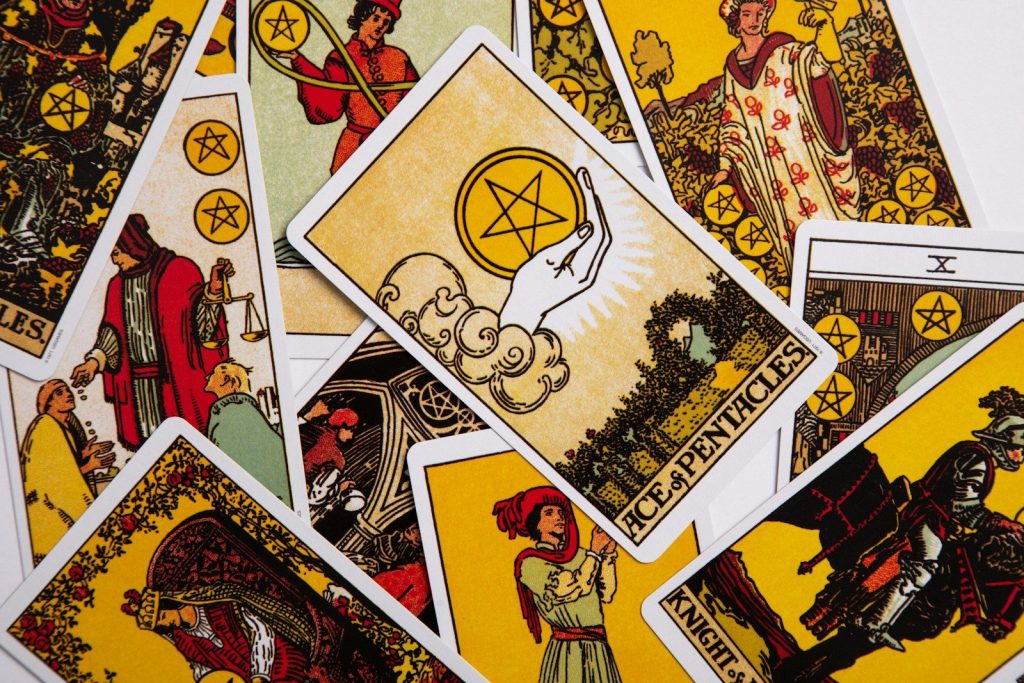
Let’s clear something up right away: tarot doesn’t tell you what’s going to happen. It shows you what’s already happening — inside you, around you, and beneath the surface of the choices you’re about to make.
The cards don’t predict the future. They illuminate the present with enough clarity that the future starts to make sense.
A Brief History of the Cards
Tarot originated in 15th-century Europe as a card game — yes, a game — before esoteric practitioners in the 18th and 19th centuries began using the imagery for divination and self-inquiry. The symbolism drawn into the cards pulled from Kabbalah, astrology, alchemy, Hermeticism, and Jungian archetypes long before Jung put a name to them.
The modern standard, the Rider-Waite-Smith deck (1909), gave us the iconic imagery most of us recognize today — the Fool on the cliff’s edge, the High Priestess seated between two pillars, the Tower struck by lightning.
But tarot has since evolved into thousands of variations, spanning every aesthetic, cultural tradition, and spiritual framework imaginable.
The Structure of the Deck
A standard tarot deck has 78 cards divided into two sections:
The Major Arcana — 22 cards representing the big themes of human experience. The Fool’s Journey, as it’s often called, moves from innocence (The Fool, 0) through lessons of ego, shadow, love, and transformation, arriving at wholeness (The World, 21). These are the cards that stop you in your tracks.
The Minor Arcana — 56 cards divided into four suits: Wands (fire/passion/action), Cups (water/emotion/relationships), Swords (air/mind/conflict), and Pentacles (earth/body/material world). These cards speak to the everyday textures of life — the arguments, the breakthroughs, the slow rebuilds, the quiet joys.
Together, they create a complete map of the human experience.
How to Actually Read Tarot
You don’t need psychic abilities. You need presence.
Tarot works best when you bring a real question — not “will I find love?” but “what do I need to understand about the patterns in my relationships right now?” The more honest the question, the more useful the reading.
Pull a card. Sit with the image. Notice what you feel before you reach for a book. The first hit is often the truest one.
Then layer in symbolism, numerology, elemental associations, and your own intuition. Over time, the cards become a language you speak fluently — one that connects you to your own inner knowing rather than outsourcing your power to external predictions.
Tarot as a Spiritual Practice
The most profound use of tarot isn’t prediction — it’s integration.
Daily card pulls build self-awareness. Spreads for life transitions create clarity in chaos. Shadow work with the cards can surface the parts of yourself you’ve been avoiding.
Paired with journaling, meditation, or plant medicine, tarot becomes a portal — not to some mystical elsewhere, but to the deepest, most honest parts of yourself.
The cards don’t lie. But they do require you to be brave enough to look.
Book a reading or explore the cards with The Cannastrologer at thecannastrologer.com
